If there is to be an all-encompassing picture for our time on the Granite Coast, let this be it. The kids together, nestled in a marvelous rock formation, on a windswept coast of rock and sand. The fun, the drama, the wind - the only thing missing would be the fabulous food we had. This incredible area of Brittany (one of the outcroppings on a northern coast of the Côtes d'Armor region) is full of surprises and, truly, a kid's (and oh yes, a grown-up's) wonderland. We've just returned from our 3-day, 2-night exploration with dozens and dozens of images swirling in our heads. Here are a few.
Tuesday, April 13: the Planetarium, the Radôme, Saint Uzec
The Radôme! Yes, that is an enormous white ball you are seeing; why yes, it does house an enormous cone-shaped antenna, and indeed, it did transmit the first-ever television images directly from America to France in 1962; and yes, that is a megalith in the foreground (and a church steeple in the background) - the megalith is from the region and was moved here to commemorate the Radôme and inscribed with a plaque by General de Gaulle. The bizarre thing is that, as I mused over the Radôme, which is now a Monument Historique (the American one in Andover, Maine was (sigh) destroyed), I started wondering out loud to Mac about Brittany's megaliths as the most ancient form of telecommunication - I don't even know why, or what I meant exactly (if satellite communication is meant to make time and distance irrelevant (in that what used to take weeks to communicate now takes seconds), megaliths, also, are involved in this compression of space and time - they are so immediate, despite their message being so mysterious) - and then, ta-da! There's a megalith. Swell - me and De Gaulle have the same commemorative thoughts! The Radôme forms part of a complex with the Planetarium de Bretagne which puts on a fantastic 3-D all-encompassing show (we followed the astounding life of stars). It (the Radôme) is also part of a museum that houses a history of telecommunications (brought to you by the big internet company here, Orange). It's one of the better museums I've been to: lots of interactive stuff for kids, and then, at the end, this breathtaking light and sound show
inside the Radôme itself. Now, French light and sound shows are the very best in the world (nothing will top the one in the Paris sewers - nothing): yes, they are overly dramatic and somewhat over the top, but they really do stir your emotions. Everything from that strange nostalgia for the Cold War (and its space race and its intrigue and its weird heroism) to the aestheticization of history emerges. Mac and I were utterly transported by our time in the Radôme (the origins of satellite communication in some ways - wow!) - the kids less so (it's an enormous echoing space filled with cold air to keep the dome plump so that it can fulfill its mission of protecting the gigantic cone-shaped antenna that receives the transmission), but they raved about the gift shop (Oliver: robot pencil sharpener; Iris: glow-in-the-dark planets; Eleanor: dolphin in a ball-shaped sea). I do have one lingering science question for any physicists or Cold War era telecommunications experts: the presented spoke of "cooling down" the airwaves as they came into the cone-shaped antenna so as to rid them of the "pollution" they had picked up on their travels from America to the satellite in space back down to France. How does one cool down sound waves??? Discuss!

One megalith per day just isn't enough, so even with the dinner hour approaching, we sought out the Christianized megalith of Saint Uzec, a mere (it turned out) 10 minutes away. I've been wanting to see this megalith for months and months and was utterly gratified and awed by it. The megalith itself is huge and (I was to learn the next day) made from rocks similar to those of the Granite Coast. It stands atop a hill with an enormous vista below - what it must have taken to haul it all the way up! And what a great place for a megalith. But I was to be most surprised by the date of the Christianization: I had always thought that this was a medieval reaction, less extreme than the c. 1000 decision to topple megaliths over, but a medieval re-inscription nonetheless. Wrong. The carvings are from the 16th century!!! They were part of a christianization campaign in the Trégor (this region) from 1674. What could a "christianization campaign" mean at this time? Surely there were no more pockets of pagan continuity in Brittany at this late date? And why did it never cross the medievals' minds to do this??? Fantastic problems.

Dinner that night at a local crêperie was especially delicious (we'd been to the future and back, after all!) and was made memorable by the discovery of what a "Kir Breton" is - why did it take me so long to discover that this marvelous concoction exists? Where a kir usually combines a bit of Crème de Cassis with white wine (preferably from Burgundy where I believe the kir originated), and where a "kir royale" substitutes champagne for the white wine, the kid Breton combines Crème de Cassis with
cider!!! Brilliant!

We made our way to our hotel with its super-friendly owner and started settling in just as the light was was fading for good around 9:30 p.m.. This was the view from our hotel balcony. Sigh.
Wednesday, April 14: The Granite Coast, the Gallic Village
How's this for one of the first sights of the day? We made our way to famed Ploumanac'h, renown for the enormous, mysterious granite rocks that line the hilly shores of the region. From the small town to Perros Guirec the "Sentier des Douaniers" (Path of the Customs Officials) stretches out along the coastline. Those guys didn't have time to rock climb: they were too busy catching the runners of the most oft-smuggled commodities: tobacco and sugar. But the kids just took off, scampering and clambering everywhere. I'll confess to having my heart in my throat during moments. You watch your children take something on with confidence and as proud as you are, flashes of what can go wrong torment you. The picture doesn't do justice to either the precipitousness of the cliffs, nor the depth of the crevisses that often appeared.

But guess what? Everything was ok! So let the rocks cliffs of the Granite Coast serve as an allegorical lesson to me. Adventure is good for it oft brings conquest. Eleanor demanded this picture - she was bursting with pride for her clambering. Honestly, I was holding on to her as much as she was holding on to me.

Oliver was the first one clambering, so it took us a while to catch up with him. But when we did, he had found this wild little cave beneath a really astounding rock - how does a rock
ripple like that? Only on the Granite Coast, I tell you. It took us a while to tear the kids away from this gathering of rocks (we were about 5 minutes into the Sentier des Douaniers!), but the promise of further "awesome" (Oliver's word) landscape did its work and on we pressed.

There's this much-needed lighthouse, what with all of the rocks that are still out to sea. The rocks look smooth (our hotel keep referred to them as giant potatoes - "les patates géantes"), but they in fact incredibly rough to the touch. I can only imagine how they would eat the keel of a boat. Mac daydreams of lighthouses (another career path and he'd have been a lighthouse keeper), so this was pretty fantastic for him.

And then this cove around one particular bend. This site is a geologist's dream, it would seem to me. Or maybe it would just be my dream to ask a geologist a million questions about
how on earth these formations came to be. This little cove was formed at some point and housed plenty of sea snails gripping onto rocks, seaweeds left in huge inviting clumps, and pools of gathered water ideal for splashing. This is the moment in which Iris declared herself a marine biologist. So be it.

We'd only made it about 15-grown-up minutes down the Sentier des Douaniers and it was already 1:30 p.m., so a quick reassessment had us picnicking on this grassy knoll overlooking...

...the beach of Ploumanac'h. When the tide is in, it comes all the way to where I was standing to take this picture, and then some. With its retreat it leaves behind oodles and oodles of treasures for the kids to find. Mac took off for a walk further (much further) down the Sentier, and I stayed with the kids to play on the beach. It was warm and sunny, ho! the treasures.

Within minutes, Oliver had found a sizeable crab on the beach. The poor thing was turned over several times by the newly minted marine biologist, but seems to have survived his ordeal: he scurried off faster than the kids could catch him again.

Eleanor was involved in that wonderfully quixotic endeavor of digging and displacing all of the sand on the beach. I don't know if you can see here how hard she's straining as she slings her sand-dirt over her shoulder. It was a totally blissful afternoon.

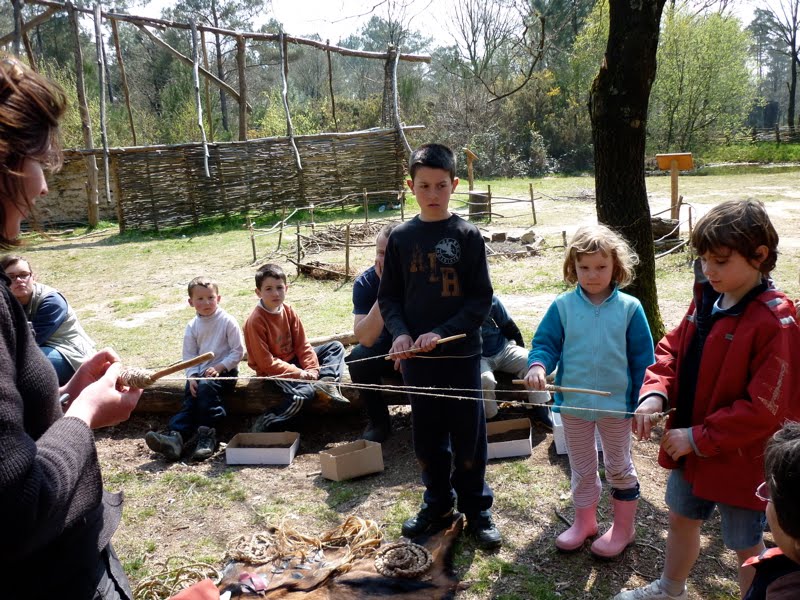
But wait there's more! Lots of fun, incongruous more! For, within a 15 minute drive, we were back to the Radôme area (see it in the background?) where a "Village Gaulois" (Gallic Village) sits. This amazing gathering of houses and games is a really cool project to benefit schools in villages throughout Togo. There was the African village above and the Gallic Village below (yes, those are some problematic alignments/similarities being drawn, and again the tension between historically specific moments and a kind of universal history and humanity were there - but deeply buried beneath the fun to be had). The alignment had limits: the African village was up above and separate from the Gallic Village below. The African village had a school room and village hall and lots and lots of information about the school project there. The Gallic Village had games all using Gallic-era mechanics and whooo, did the kids have fun.

Oliver enjoyed his time as chieftain being carried around on a shield (as the chieftain of Asterix and Obelix's village is).

Iris went for more of the benevolent despot look.

If you've read any of the Asterix books, you know how important the Potion Magique is (for a limited time, it gives them superhuman strength to fight the Romans). Thus, the hauler o' the Potion Magique is a most revered individuals. Just so you know, Oliver is in the last barrel, he's just hiding so he can pop up and...

... well, you get the picture :-)

All that Iris wanted as soon as we stepped into the Gallic Village was to go on a boat ride. I'd put her off as long as possible (all those chances to keel over, the wet, etc. and (and this deserves longer commentary) European things for kids are just not as kid-proof as American things for kids - probably why they can often be more adventurous and fun - a post on this someday), but there was no stopping her - plus Mac really wanted to do it, too. So in we went. I was so stressed out about keeping Eleanor from falling in that I forgot an oar, so dear Mac had to do all of the work (which included correcting for whatever Oliver and Iris were doing with their oars). It was a gorgeous little boat ride, complete with snoozing goose in the background. I love the look of conquest on Iris's face. Oliver, as ever, is blissed out. Eleanor and I are clinging to each other speechlessly (kind of nice, actually).

After the boat ride, there was time for one more game: the two-person enormous long skis event! Guess who was the organizer? Man, can that child bark out orders! Her hair flying in all directions bespeaks her efforts. Meanwhile, Oliver's little tongue lolling out of his mouth lets you know he'd rather be boating. You'll notice the park is pretty much cleared out, but they're still going for it.

And indeed, it is in this moment (at the end of a great day, as a vigorous afternoon is waning) that Mac and I love France the most, for its proffering forth of much-needed espressos at just the right moment: three minutes before closing time. The valiant delivery man of Potion Magique is thus richly rewarded.

So here's the part where I must pay homage to my children. After this long, incredible day, we nonetheless ventured forth (after the obligatory vacation watching of "Les Simpsons" at 6:30 p.m. in the hotel) for a dinner of gorgeous seafood in an exquisite restaurant that only opened at 7:45 p.m.. We were taking our chances (tired, exuberant kids + fine dining = ???), but they were just marvelous. Curious about the food (Mac tried to sneak in a photograph of his appetizer: "canoli" in which the smoked salmon
were the canoli wrappers themselves), eager to try everything (the beautiful little orange fish eggs on the crème fraîche did not last long!), and just lovely. Reading lots of
Asterix helped, but we also talked and talked during our two and a half hour meal. The restaurant was also really good to us: a fish soup was brought out in three bowls for the kids, and an order of fish was also divided into three tiny portions. The food was unbelievable: just so fresh, and the sauces so delicate, and all sorts of unexpected vegetables (turnips and fish are great together, who knew?). I wish that I'd written down the dishes themselves - each dish was a little poem.

Dessert for the kids came in the form of an ice cream clown whose nose was a piece of chewing gum! So this tells me a few things: that kids frequent this delicate, beautiful restaurant enough that they have a standard kid dessert in stock, and that I therefore shouldn't be gushing with quite so much pride as children in a fine restaurant is a common enough occurrence in France. :-) But I was nonetheless: I think that it was watching them enjoy the food that made me happiest. Dear, dear America: let it be known: children do enjoy good food!!! Plus, the
Asterix we're reading had a lot of dinner parties in it so there was some nice continuity there (granted, the Asterix dinner parties involved a lot more wine being drunk out of bull's horns, but each of these parties ended with an absurdly deployed "Farpaitement!" ("Ferpectly!") which we used to conclude each course - not too loudly!).
Thursday, April 15: Ploumanac'h beach, Kermaria-en-Insquit
We couldn't resist going to the beach one more time before leaving and I'm glad we did because it was an entirely different landscape that greeted us. Where the previous day had been warm and sunny, with patches of gentle breezes, today was cold and raw with a really strong wind whipping through. The castle on the little island across from the beach looked so much more forbidding today. The beach was ours and the kids were undeterred: they dug and explored and collected and scampered as much as yesterday. This time, Iris found an enormous sea slug: I watched it unfurl in her calm little hand and was too stunned to remember to take a picture.

We could practically chase the tide out to sea (as it has chased us in to shore the previous afternoon) - it's that fast (a slow walking pace, but a pace nonetheless). There's something about seeing your little family amidst a rocky terrain that is windswept and ocean guarded that makes you want to hold on to everything, keep it just so: adventurous and beautiful, all thing possible yet safe in that moment. And so it was with that feeling that we left Ploumanac'h (after a lunch of mussels and sardines!).

We'd had all sorts of plans to see too many (three) more things on our way home and found ourselves scaling back so as to enjoy lunch and let the kids rest of the ride home. In the end, we stopped only once (as my mom always says, you have to leave something for next time!), but what a stop! In the late 14th-century, the little 13th-century chapel of Kermaria-en-Isquit was adorned with a full cycle of the Danse Macabre (based on the 1425 Paris cycle which itself had been popularized through woodcuts). Death leads the mightiest of the mighty and the lowliest of the low in his herky jerky dance. Macabre? yes. Funny in its own macabre way? yes. An utterly unique art historical treasure? You bet. The church still has its wooden vaulting (restored in the main nave, but I swear that's original, or at least late medieval, work in the side aisles); it has dozens of 13th-15th century painted statues, and (wonder of wonders), some of the remaining Dance of Death figures still have their text underneath: the macabre, witty back and forth between Death and his next victim (he tells the Knight, for instance, that it's time to step away from the waltz with the ladies to dance another dance - his). Seeing the text and the images in their original setting makes these images come alive like nothing else I've ever seen. This will entirely change the way that I teach the "Death" section of the Gothic class (having looked closely at the "three orders" (those who pray, those who fight and those who labor) for the first half of class, we look at five categories experiences for the second half: devotion, space, time, death, and salvation).

I'll end with this image which, I will argue, lodges its own witty resistance to Death's inevitable dance, a resistance with a particularly Breton flavor. The figure to your left is Death in profile joining up with a Musician before him. The central figure is said Musician and the figure to the right is Death again, leading our Musician on. Our poor fellow hesitates to join the Dance, and, where all the other figures hold on to the object that makes them who they are (the bishop holds his crozier, the knight his sword, etc.), our musician has dropped his instrument. You see it lying at his feet. It's a biniou, the classic Breton bagpipe and I'd wager, from what I know of the Breton spirit so far, that he's dropped it on purpose, for the next biniou player to pick up and continue playing the Fest music of the living!
Kenavo, everyone!
 We keep looking for the cloud of ash that has absolutely stilled European air travel, but all we see is blue sky. Well, it is 8km (about 5 miles) up, and it is very fine. But still, it's odd to be able to picnic and have a leisurely day in the sun while the news rages on about the thousands of people stranded in various airports. It's as much the weather (and its holding pattern) as the volcano (which has been erupting since March 20th), and I'm holding out hope that the weather will move along faster than the volcano. There are some pretty amazing slide shows out there, and reports of glass (glass?) and boulders being spewed out, as well as bolts of lightning (lightning?) coming from the cloud forming above the volcano. The most amazing element of it all may be the name of the glacier under the volcano: "Eyjafjallajokull." I haven't seen a single reporter attempt to pronounce it yet - daunting!
 So, Iris's invented Tic Tac Toe board, made of sticks and stems and flowers and clovers, seems a little incongruous with the day, but here it is. We're still planning to leave on our second little vacation outing: 3 days/2 nights in the Finistère, to the edge of the world! The world in our France life, as Iris continues to say.
 Our second café/ice cream in a terrace! It's really starting now, with week-ends being much busier in Josselin, and sidewalk tables starting to sprout up everywhere. See how sunny and warm it is? Almost weird!
 It's been such a beautiful day that we couldn't really go inside, so we went to the Bois d'Amour instead (having picnicked at the Lists) and to my amazement, I started making little chains made of daisies (all good unless the stem breaks!). Iris soon had several designs for jewels in mind. This is the princess crown - love the big gem (rose petal) in the middle of the flowers. And the knowing but the kind look of my little girl.